
Introduction
At Dybaja, people often see the final result first. A cinematic visual, a refined fashion concept, or a complete brand identity shaped through AI powered workflows. What is rarely seen is the journey behind that result.
A successful AI project does not begin with a prompt. It begins with clarity.
Before we open any AI tool, before we define lighting, lenses, or composition, we focus on understanding the real problem. Because technology without direction only produces noise. Strategy is what turns AI into impact.
Phase One
Understanding the Goal Before Using Any Tool
Every project we take on begins with one essential question: why?
Why does this brand need this content?
What problem are we solving?
What emotional response are we designing for?
Whether we are working on heritage inspired fashion, a product launch campaign, or a cinematic brand story, our role is not to generate visuals. Our role is to translate identity into experience.
In one of our culture driven projects, the objective was not simply to produce beautiful imagery. The goal was to reinterpret heritage in a way that felt contemporary without losing authenticity. That required research, sensitivity, and strategic positioning long before AI entered the conversation.
Phase Two
Building the Vision Before Writing the Prompt
AI tools operate through language, but creativity begins in imagination.
Before writing a single prompt, we map the visual direction. We define the emotional tone, lighting atmosphere, camera perspective, movement, color hierarchy, and brand alignment. Sometimes we even sketch ideas or write descriptive mood narratives to clarify the intention.
Only when the vision is fully shaped do we begin crafting the prompts.
This is where expertise matters. Prompt engineering is not about stacking keywords. It is about translating strategy into structured language that AI can interpret correctly.
The clearer the internal vision, the more precise and aligned the generated result becomes.
Phase Three
Testing, Refining, and Rebuilding
This stage is invisible to most clients.
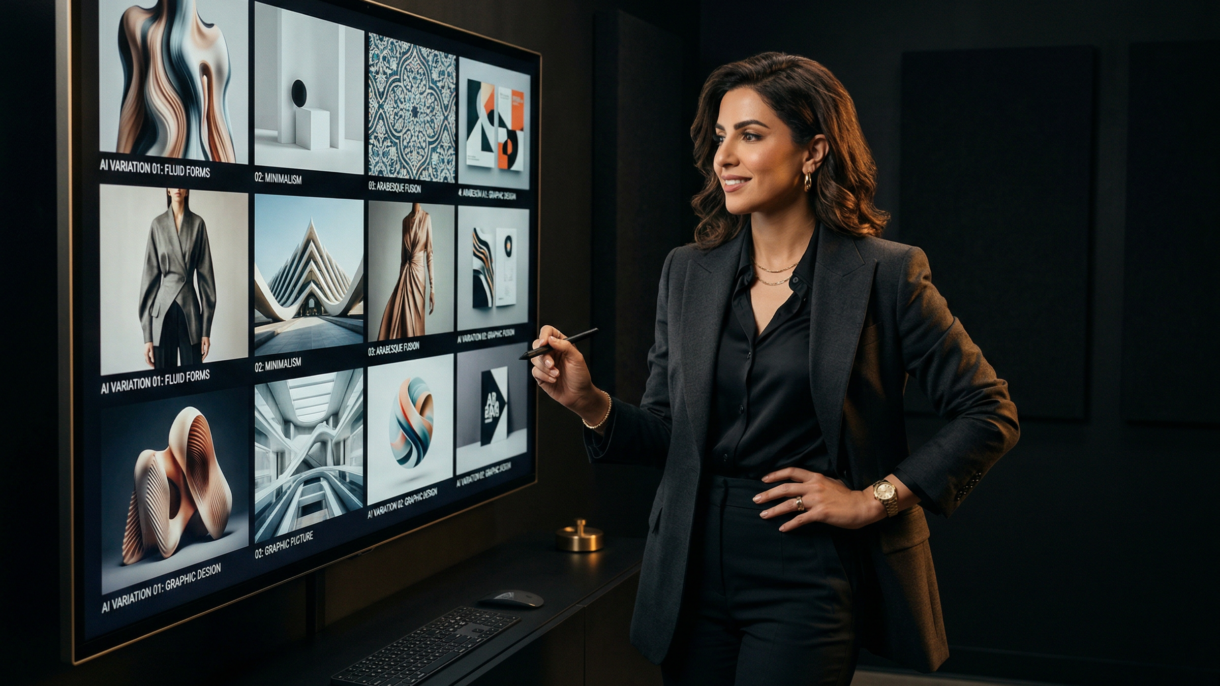
We generate variations.
We refine composition.
We adjust lighting logic.
We correct proportions.
We rebuild prompts.
Sometimes we discard strong visuals because they do not serve the strategic objective.
AI gives speed, but it does not remove the need for discernment. The challenge is resisting the temptation of immediate beauty and staying committed to meaning.
Many assume AI is a shortcut. In reality, high level AI creative work involves structured experimentation, aesthetic judgment, and repeated refinement.
The first result is rarely the final result.
Phase Four
Integration Into a Complete Experience
Once the visuals reach the required level of quality, we move into integration.
Does this align with the brand’s positioning?
Do the colors support the emotional goal?
Is the narrative coherent across platforms?
Does the final output strengthen trust or only impress visually?
AI generated visuals must connect with voice, typography, user experience, campaign structure, and brand identity.
At Dybaja, we do not treat outputs as isolated images. We treat them as components within a larger system. Only when everything works together does the project truly succeed.
The Real Challenges in AI Creative Work
The AI era has created unprecedented opportunity, but it has also created saturation.
There is repetition in styles.
There is pressure for instant results.
There is hesitation from clients who fear losing authenticity.
There is increasing difficulty in standing out.
This is why strategic thinking has become more valuable than ever.
AI is not a replacement for expertise. It amplifies it. Without direction, it produces generic outcomes. With clarity and refined vision, it becomes a powerful creative accelerator.
Conclusion
People often see the final image. We see the process behind it.
We see the questions asked at the beginning.
The drafts that were discarded.
The experiments that refined the idea.
The strategic choices that shaped the direction.
A successful AI project is not defined by how quickly it was generated. It is defined by how intentionally it was designed.
At Dybaja, we combine strategy, advanced AI workflows, and human centered refinement to create visual experiences that carry meaning, structure, and impact.
Because in the end, AI is a tool. Vision is what turns it into value.
How This Approach Shapes Our Services
This structured process is not theoretical. It defines how we operate at Dybaja.
When brands partner with us, they are not simply looking for AI generated visuals. They are looking for clarity, distinction, and creative direction in a saturated digital landscape. Our services are built around strategic AI implementation, advanced visual development, and human centered refinement.
We work across AI powered fashion concepts, heritage driven storytelling, cinematic campaign creation, product visualization, and brand identity development. In every project, we combine structured creative workflows with deep cultural awareness and aesthetic precision.
For brands that want to move beyond generic AI outputs and build meaningful visual systems that reflect who they truly are, this is where we begin.